Age-Related Muscle Loss: A 47-Year Study’s Hopeful News After 40
Think back to the strongest you have ever felt. Maybe you were carrying a toddler on each hip, hauling hay bales, or running up the stadium stairs without a second thought. For most of us, that memory comes from our late 20s or early 30s. Then life got busy, and one day the grocery bags felt a little heavier.
Most of us were told that age-related muscle loss is something that happens “when you get old.” A remarkable Swedish study that followed the same group of people for 47 years tells a different story. It found that fitness and muscle endurance tend to slip much earlier, and then the slide speeds up after midlife.
This research from Karolinska Institutet was first published in late 2025. ScienceDaily revisited it this week with new follow-up findings in a story titled “A 47-year study reveals the age when your body starts losing strength.” The headline sounds discouraging. The details are anything but, because the study also found that people who started moving later in life still did better.
In my practice I see this every week. A patient in their 50s or 60s tells me, “Doctor, I guess it’s too late for me.” Here is what I tell them, and what I want you to hear today: don’t panic, and don’t wait.
🔬 What the 47-Year Study Found About Age-Related Muscle Loss
The research comes from the Swedish Physical Activity and Fitness study, called SPAF for short. In 1974, researchers chose 427 Swedes at random, all born in 1958 and 48 percent of them women. They then tested the same people again and again, from age 16 all the way to 63. The results were published in the Journal of Cachexia, Sarcopenia and Muscle.
That design is what makes this study special. Most aging research compares young people with older people at a single moment in time. According to Karolinska Institutet’s press release, SPAF is one of the few studies to measure fitness and strength in the same random sample for nearly 50 years.
The key findings
- The peak came early. Maximal aerobic capacity (how well your heart, lungs and muscles use oxygen during hard effort) and muscular endurance (how many bench press repetitions a person could do) peaked between ages 26 and 36 in both men and women.
- The slide started gently, then sped up. At first, capacity dropped only about 0.3 to 0.6 percent a year. Later it accelerated to about 2.0 to 2.5 percent a year. Men and women declined at the same rate.
- It adds up. From peak to age 63, overall physical capacity fell by 30 to 48 percent.
- Power peaked even sooner. Muscle power, measured by jump height, peaked at age 27 in men and age 19 in women. Power is strength delivered with speed, the kind you need to catch yourself if you trip.
- People grew more different with age. The variation in relative aerobic capacity rose 25-fold from adolescence to age 63. In plain English, some people stayed far fitter than others.
- Activity made a difference. Being more active in leisure time at age 16, and becoming active as an adult, were both associated with better performance on every measure.
Recent Research
Karolinska Institutet reports that people who became physically active in adulthood improved their physical capacity by 5 to 10 percent. The lead author notes that activity can slow the decline, though it cannot completely stop it.
What this study can and cannot tell us
I always want you to understand the science honestly. This was an observational study in people, which means it shows links, not proof. It cannot prove that exercise caused the better results, only that active people tended to perform better.
It also followed one generation in one country, people born in Sweden in 1958, so results may look different elsewhere. Some measurements were estimated with statistical models. And the “mid-30s peak” is a population average, not a cutoff for you personally. You will not wake up weak on your 36th birthday. As always, one study is not the final word, but it lines up with what decades of exercise research have shown.
🧬 When Does Muscle Loss Start, and Why Does It Speed Up?
The honest answer to “when does muscle loss start” is: earlier than most of us expect, and quietly. The authors concluded that the decline can be seen before age 40. In the early years, a loss of less than one percent a year is easy to miss. You simply adjust, carrying one less box or taking the elevator a little more often.
Your muscles are living, responsive tissue. God designed them to answer the demands you place on them. When you ask them to lift, climb and carry, they hold their ground. When you stop asking, your body slowly stops investing in tissue it thinks you no longer need. I tell patients that muscle is like a savings account: what you deposit in your 40s and 50s is what you draw on in your 70s and 80s.
The researchers warn that this slow slide can later lead to clinically significant physical dysfunction, especially in people who are sedentary. More advanced muscle loss can lead to a condition called sarcopenia, which is the medical term for a significant loss of muscle mass, strength and function with age. Only your doctor can evaluate that, so if you have concerns, bring them to your next appointment.
That is the sobering part. Now let me show you why I am so hopeful.
📈 The Hopeful Part: Why Your Choices Still Matter
Remember that 25-fold growth in differences between people? That is the headline I want you to remember. By age 63, some participants were in far better shape than others born the same year. Aging set the general direction, but daily choices appear to shape how steep the hill becomes.
The new ScienceDaily report also describes several follow-up studies that add to the picture:
- Healthier arteries. In SPAF participants, better aerobic fitness at ages 34 and 52 was linked to less arterial stiffness at age 63. Arterial stiffness means your blood vessels have become less flexible, which makes the heart work harder.
- Lifelong athletes still age, but well. A 2026 study of 82 older cyclists found a 19.7 percent drop in peak aerobic capacity over 9 years. Yet most of them stayed at or above the 90th percentile for their age.
- Strength responds even in the 60s, 70s and 80s. A small 4-year study of 49 men aged 60 to 82 found that weekly resistance training improved strength, though participants chose their own programs.
Other research points the same way. A cross-sectional study of 193 adults aged 65 to 70 found that those who did muscle-strengthening exercise twice a week had a significantly lower sarcopenia risk score, even if they already met the 150-minute aerobic guideline. Again, that shows an association, not proof. UCLA Health also cites a study of more than 500 older women with sarcopenia in which resistance training at least twice a week improved muscle strength and walking speed.
Here is the takeaway: walking is wonderful, and I want you to keep doing it. But walking alone is not enough to protect your muscles. You need to lift, push and pull something on purpose.
Fast Fact
The CDC recommends that adults 65 and older get at least 150 minutes of moderate aerobic activity a week, muscle-strengthening activity on at least 2 days, and balance activities. The CDC states that people benefit from physical activity throughout life.
💪 How to Build Strength After 40: 6 Natural Habits
You do not need a fancy gym or an expensive trainer. You need consistency, a little courage and a plan. In The Seven Pillars of Health, I describe movement as one of the foundations of a healthy life, right alongside water, sleep, good food and managing stress. These six habits put that pillar to work.
Lift on Purpose, 2 to 3 Days a Week
Mayo Clinic suggests training 2 to 3 days a week with 48 hours of rest between sessions. Dumbbells, resistance bands, or your own body weight all count.
Make the Last Rep Count
The CDC advises 8 to 12 repetitions per exercise, done until one more would be hard without help. That is one set, and one set is a fine place to start.
Go Slow and Use Full Range
Move slowly through the full range of motion. Control protects your joints and makes each repetition do more work. Progress gradually to avoid injury.
Keep Your Heart and Lungs Busy
Aerobic fitness was a key measure in this study. Brisk walks, cycling, swimming or a game like pickleball help build toward 150 minutes a week.
Train Your Balance
The CDC includes balance activities for older adults. Stand on one foot while brushing your teeth, holding the counter, or try a heel-to-toe walk down the hallway.
Fuel and Rest the Muscle
Muscle is built during recovery. Eat quality protein from whole foods like eggs, fish, poultry and beans at your meals, and protect your sleep.
If you enjoy company, make it social. We have written before about the benefits of exercising with your spouse, and about why pickleball has become a favorite for healthy aging. A workout partner keeps you accountable on the days you would rather stay on the couch. If you are curious about nutrition for muscle in older adults, we also looked at the research on creatine and muscle in older adults in an earlier article.
A simple starter routine for strength training over 50
Here is a beginner routine many of my patients use at home. Pick 4 or 5 moves, do one set of 8 to 12 slow repetitions each, and rest a day between sessions:
- Chair sit-to-stands for your legs and hips, the muscles you use to get out of a car.
- Wall or counter push-ups for your chest, shoulders and arms.
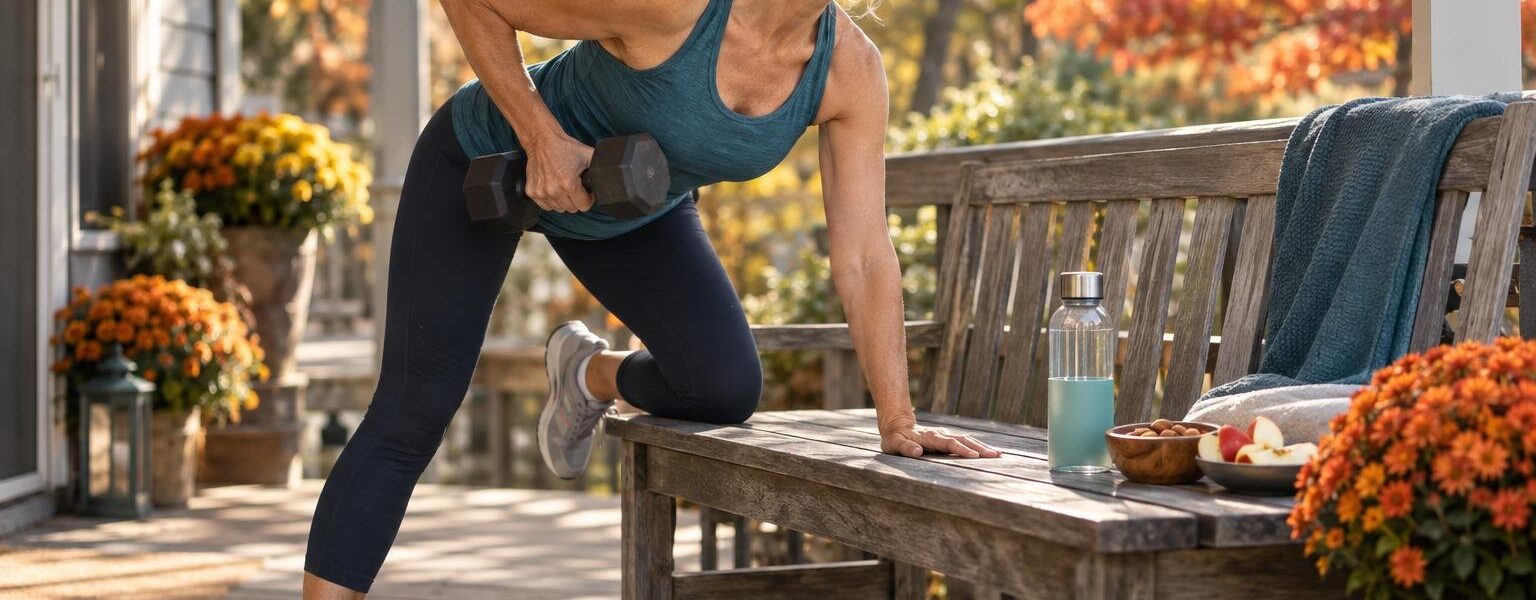
- Band or dumbbell rows for your upper back and posture.
- Step-ups on the bottom stair, holding the railing.
- Farmer’s carry: walk slowly while holding a light weight in each hand, just like carrying groceries.
When 12 repetitions start to feel easy, add a little weight or a second set. That gradual challenge is what tells your body, “Keep this muscle. We still need it.”
✦ Dr. Colbert’s Faith Perspective
Strength for the Years God Gives Us
Our bodies are gifts to steward, not idols to worship. Paul wrote, “For bodily exercise profits a little, but godliness is profitable for all things, having promise of the life that now is and of that which is to come” (1 Timothy 4:8, NKJV). Notice he did not say exercise profits nothing. It profits a little, and that little can mean the strength to lift a grandchild, serve at church, help a neighbor or kneel and rise again in prayer.
I love God’s picture of the righteous in later life: “They shall still bear fruit in old age; They shall be fresh and flourishing” (Psalm 92:14, NKJV). Caring for your strength is not vanity. It is a way of staying ready to serve God and others with every year He grants you. And if you feel you have waited too long, take heart. The God who renews is never late.
“But those who wait on the LORD Shall renew their strength; They shall mount up with wings like eagles, They shall run and not be weary, They shall walk and not faint.” (Isaiah 40:31, NKJV)
“You cannot choose the year you were born, but you can choose what your muscles do this week. Every set you finish is a deposit into the strength you will need for the decades God still has planned for you.”
Dr. Don Colbert, MD
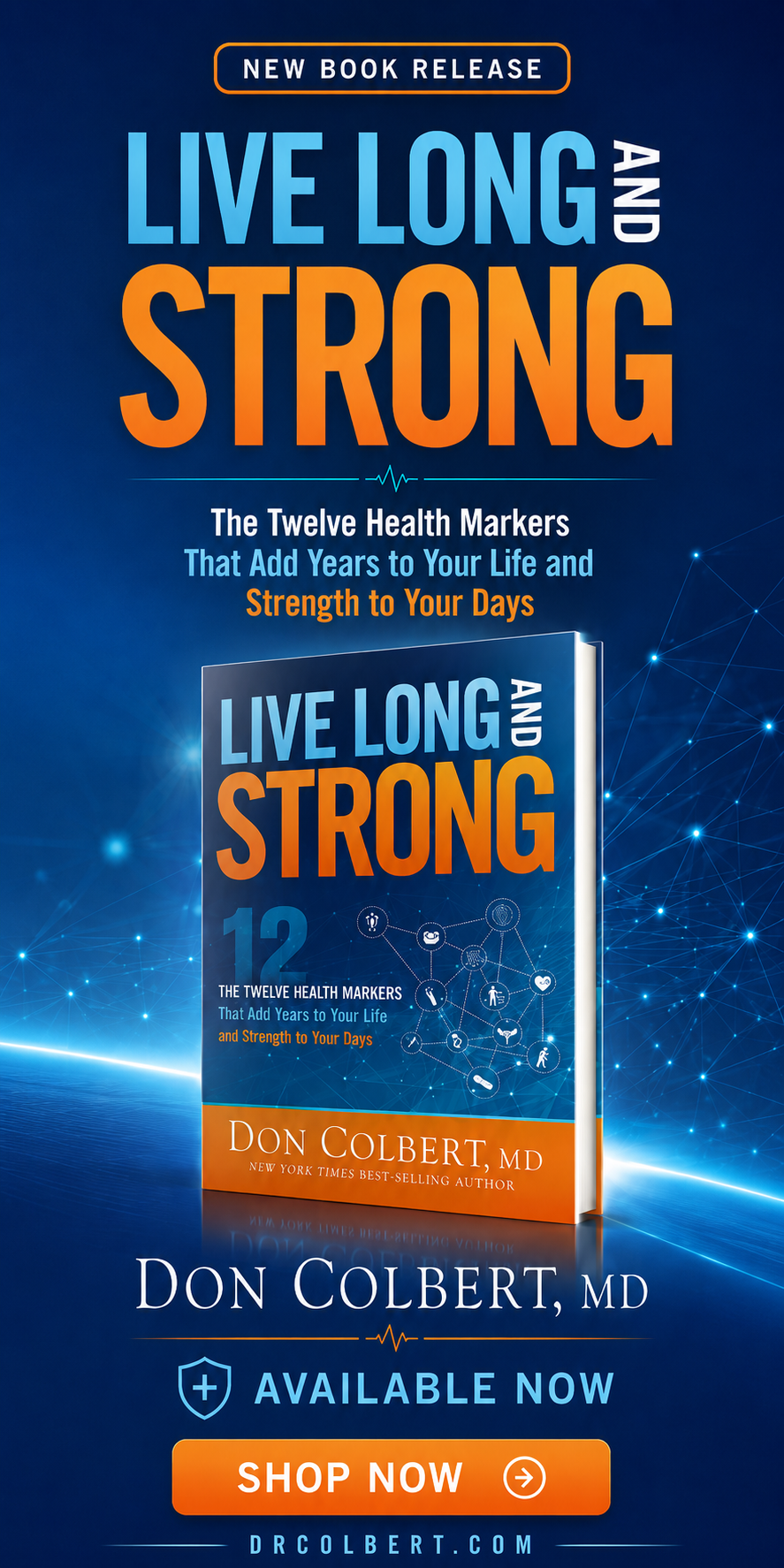
This subject is so close to my heart that I wrote my newest book about it. In Live Long and Strong, I walk you through the health markers I watch most closely in my patients as they age, including the strength that keeps you independent.
From Dr. Colbert’s Bookshelf
Live Long and Strong: The Twelve Health Markers That Add Years to Your Life and Strength to Your Days
If this study made you wonder where you stand, this book is your next step. I explain twelve health markers worth tracking as you age, why muscle and strength matter so much for longevity, and how to build a practical, faith-filled plan to stay active and independent. It pairs beautifully with The Seven Pillars of Health if you want to strengthen the basics first.
📝 Your Action Plan to Slow Age-Related Muscle Loss
- Talk with your doctor first if needed. If you have heart disease, joint problems, osteoporosis, a long history of being inactive, or chest pain or dizziness with exertion, get your physician’s blessing before you begin.
- Schedule two strength days this week. Put them on your calendar like appointments, with at least one rest day between them.
- Start light. Use body weight or light dumbbells or bands, one set of 8 to 12 slow, controlled repetitions per exercise.
- Add a little each week. When the last repetition gets easy, add a small amount of weight, a few repetitions or a second set.
- Walk briskly most days. Build toward 150 minutes of moderate aerobic activity a week, even in 10-minute pieces.
- Practice balance daily. Spend a minute standing on one foot near a counter, then switch sides.
- Feed your muscles and rest them. Include whole-food protein at your meals and make sleep a priority.
- Invite someone along. A spouse, friend or small group from church makes it more joyful and easier to stick with.
- Dedicate it to the Lord. Before each session, thank God for your body and ask Him for strength to serve with it.
❓ Frequently Asked Questions
At what age does muscle loss start?
In the 47-year Swedish study, aerobic capacity and muscular endurance peaked on average between ages 26 and 36, and the decline could be seen before age 40. It begins slowly, at about 0.3 to 0.6 percent a year, and later speeds up to about 2.0 to 2.5 percent a year. These are averages, and individuals vary widely.
Is it too late to build strength after 50 or 60?
No. In the SPAF study, people who became active as adults performed better on every measure, and Karolinska reports their capacity improved by 5 to 10 percent. A small study of men aged 60 to 82 also found weekly resistance training improved strength. Exercise appears to slow the decline, even though it cannot stop aging altogether.
How often should older adults do strength training?
The CDC recommends muscle-strengthening activities on at least 2 days a week for adults 65 and older. Mayo Clinic suggests 2 to 3 days a week with 48 hours of rest between sessions. Aim for 8 to 12 repetitions per exercise, and progress slowly.
Can you prevent sarcopenia naturally?
No one can promise that, and only your doctor can evaluate whether you have sarcopenia. What research does show is that regular muscle-strengthening exercise is associated with a lower sarcopenia risk score in older adults. Staying active, eating whole foods and getting good sleep are wise steps for everyone, and your doctor can guide you if you have concerns.
🙏 A Final Word
I hope this study does not discourage you. I hope it wakes you up. Yes, our physical capacity begins to drift sooner than we thought. But the most striking finding in 47 years of data was how different people became by their 60s, and those differences were linked to how they chose to live.
You are fearfully and wonderfully made, and your body still responds when you ask it to grow stronger. Start where you are, start light, and keep going. Pick up those weights this week, and let every repetition be an act of gratitude to the One who gave you breath and strength.
Blessings to you on the journey,
Dr. Don Colbert, MD
Sources
- A 47-year study reveals the age when your body starts losing strength, ScienceDaily (source: Karolinska Institutet), 2026
- Westerståhl M, et al. Rise and Fall of Physical Capacity in a General Population: A 47-Year Longitudinal Study, Journal of Cachexia, Sarcopenia and Muscle, 2025
- Long-term study reveals physical ability peaks at age 35, Karolinska Institutet, 2025
- Older Adult Activity: An Overview, Centers for Disease Control and Prevention
- What Counts as Physical Activity for Older Adults, Centers for Disease Control and Prevention
- Engagement in Muscle-Strengthening Activities Lowers Sarcopenia Risk in Older Adults Already Adhering to the Aerobic Physical Activity Guidelines, PubMed Central (NIH)
- Strength Training for Adults (MC2972), Mayo Clinic
- Why strength training is critical for older adults, UCLA Health
Was this helpful?
Get Dr. Colbert's weekly health tips
Simple, faith-filled health tips in your inbox once a week. Plus a free gift: the 21-Day Keto Zone Challenge.
Unsubscribe anytime. We never share your email.
What stood out to you most, and have you tried any of this yourself?
Tell us on Facebook