
Strength Training for Seniors: 4 Simple Moves, 4 Minutes a Day

Picture a quiet morning. You set down your coffee, push yourself up from your favorite chair, and for a moment you notice it: your legs do not answer the way they used to. If you are over 65, that small moment can feel bigger than it looks. Getting out of a chair is really about getting on with your life.
Here is the encouraging news. Strength training for seniors does not have to mean a gym membership or an hour out of your day. A new randomized trial from Penn State, published in PLOS One and recently reported by ScienceDaily, tested a simple four-minute routine done at home every day. After 12 weeks, inactive adults 65 and older who already had trouble walking did more chair stands, rose from a chair faster and balanced longer on one leg than people who did not do the routine.
Just as remarkable, most of them stuck with it. In my practice I often see that the biggest obstacle to exercise after 65 is not ability. It is time, complexity and discouragement. This study speaks right to that problem, so let’s walk through what it found, what it did not find and how you can begin this week.
🔬 What the New Penn State Study Found
The study is called FAST-2. It was a randomized controlled trial, which means volunteers were assigned by chance either to the exercise program or to a comparison group. Randomized trials are one of the most reliable ways to test whether something actually makes a difference.
The full paper, “Brief daily functional strength training to improve functional performance in older adults with mobility disability”, was published in PLOS One in March 2026. The program was done at home, and participants were coached remotely by video.
Who Took Part
The researchers enrolled 97 adults aged 65 or older: 44 in the exercise group and 53 in the control group. Their average age was 74, and 68 percent were women. All of them were inactive, with under 60 minutes of activity a week and no resistance training, and all of them reported difficulty walking a quarter mile.
At the start, they averaged only about 18 minutes of total activity per week. These were not athletes. They were people much like many of my patients, and perhaps much like you or someone you love. Because coaching happened by video, everyone needed internet access.
The 4-Minute Workout for Seniors, Move by Move
The routine had four exercises, each done for 30 seconds and followed by 30 seconds of rest: push-ups, chair stands, two-arm rows with a resistance band, and stair stepping. That adds up to four minutes a day, seven days a week. Only 60 seconds of that time actually worked the legs.
Participants could modify the moves, and they did so in about 41 percent of sessions. The most common change was doing push-ups against a wall or kitchen countertop instead of the floor. That is an important detail: you do not have to get down on the ground to take part.
What Changed After 12 Weeks
To understand the results, it helps to know the tests. The 30-second chair stand test counts how many times you can stand up from a chair and sit back down in 30 seconds. The five-times sit-to-stand test times how long it takes to rise and sit five times. The one-legged stance test measures how long you can balance on one foot.
Compared with the control group at 12 weeks, the exercise group:
- Did 4.2 more chair stands in 30 seconds.
- Held a one-legged stance 3.6 seconds longer.
- Cut their five-times sit-to-stand time by 2.3 seconds more than the control group.
The authors note that the chair-stand improvements meet published thresholds for a “minimum clinically important difference.” That simply means a change big enough to matter in daily life, not just on paper. For the 30-second test, that threshold is 2 or more repetitions, and for the five-times test it is 2.3 seconds.
Repetitions climbed steadily, too. Over 12 weeks, average push-ups rose from 8.1 to 17.5, chair stands from 7.6 to 16.7, band rows from 10.6 to 27.5, and stair steps from 8.7 to 15.8. Each number roughly doubled, and in rows it more than doubled.
Recent Research
People kept showing up. Participants completed the workout on 81 percent of days, about 5.6 days a week. Only 11 percent of the exercise group dropped out, compared with 28 percent of the control group.
What the Study Did Not Show
I always want you to have the whole picture. This was a small study that lasted only 12 weeks. Because of COVID restrictions, results were measured over video, and some gold-standard tests, such as the six-minute walk, were not done. The study was not blinded, so both participants and staff knew who was exercising, and the control group simply continued their usual care.
The study measured performance on chair-stand, balance and sit-to-stand tests. It did not measure falls, nursing-home entry or muscle mass. The authors also state that it does not show four minutes a day is enough to improve body composition or cardiovascular health in the general population.
Two more points matter for transparency. Dr. Sciamanna, the researcher described as the study’s lead author, is part-owner of two exercise-related companies, BandUp, Inc. and Play Fitness, LLC, and the study reported no specific funding. One study is never the final word, but this is a careful, honest step in a hopeful direction.
🦵 Why the Chair Stand Exercise for Older Adults Matters So Much
You might wonder why researchers care so much about standing up from a chair. That one motion uses the same muscles you need to climb stairs, get out of a car, rise from the toilet and steady yourself when you stumble. Your thighs, hips and core have to produce force quickly, and your brain has to coordinate them smoothly.
This approach is called functional strength training, which means practicing the exact movements of everyday life. Our bodies are fearfully and wonderfully made, and they respond to what we ask of them. When you practice standing up, the nerves and muscles involved in standing up learn to work together. That may help explain how such a short routine produced measurable changes in people who had been very inactive.
According to Penn State, Dr. Sciamanna says chair-stand and balance tests predict future falls, walking difficulty and the need for care. That matters. The CDC reports about 37 million falls each year among adults 65 and older, about 9 million fall injuries and about 41,000 fall deaths. Falls account for 56.1 percent of unintentional-injury deaths in this age group.
Let me be careful here. The FAST-2 trial did not measure falls, so we cannot say this routine prevents them. What we can say is that it improved the very tests researchers use to gauge how well older adults move.
Did You Know?
In a separate observational study of older adults, the Toledo Study for Healthy Aging, low sit-to-stand power was linked to more past falls and fractures, more hospitalization and higher risk of death over 9 years (57 percent higher in men and 104 percent higher in women). This shows an association, not proof that improving the test lowers risk.
The Real Obstacle Is Time and Discouragement
According to Penn State, fewer than 1 in 5 older adults do the recommended two days a week of muscle-strengthening. I understand why. Many programs feel complicated, time-consuming or intimidating. When someone already struggles to walk, the gap between where they are and where they think they should be can feel overwhelming.
Four minutes changes that equation. Almost anyone can find four minutes, and a small daily habit is easier to remember than a long weekly one. As Dr. Sciamanna put it, “Exercise is the key to freedom.”
This trial builds on an earlier pilot called FAST-1, in which 24 older adults did 30 seconds of push-ups and squats daily and improved their squat performance over six months. If you read my article on age-related muscle loss, you know how much I care about protecting our strength as we age. This research tells me the door is open wider than many people think.
🏠 How to Start Strength Training for Seniors at Home
Here are the four moves from the study, with the safety tips I give my patients, plus two habits that round out a healthy week. Keep the rhythm simple: 30 seconds of the move, 30 seconds of rest, then on to the next one. Please get your doctor’s okay first.
Wall or Countertop Push-Ups
Stand about an arm’s length from a wall or sturdy counter with your hands at shoulder height. Bend your elbows to bring your chest toward it, then press back. Shoulder discomfort was the most common complaint in the study, so keep the motion smooth and pain free.
Chair Stands
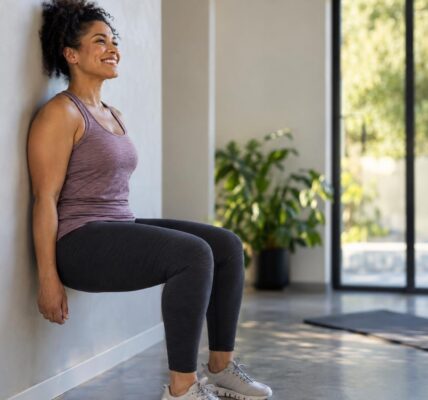
Push a sturdy chair firmly against a wall. Sit near the front with your feet flat, stand all the way up, then sit back down slowly and with control. Use the armrests to help at first if you need them.
Two-Arm Band Rows
Loop a light resistance band around a sturdy post or secure anchor. Hold one end in each hand and pull your elbows back as you gently squeeze your shoulder blades together. This works the upper back muscles that help you stand tall.
Stair Stepping
Step up onto the bottom stair and back down, alternating your lead leg. Keep one hand on a rail, wall or counter the whole time. Choose a steady pace you can fully control.
Add a Daily Walk
The four-minute routine is a starting point. The CDC recommends at least 150 minutes a week of moderate aerobic activity for adults 65 and older, plus balance activities. Build toward it gradually, a few minutes at a time.
Pair It With Prayer
Attach your four minutes to something you already do, such as morning devotions or your first cup of tea. A familiar anchor makes a new habit far easier to keep.
How to Build Leg Strength After 65 Without Overdoing It
Start where you are. In the study, people began with about 8 chair stands in 30 seconds and roughly doubled that over 12 weeks. You do not need to rush. Control, good form and consistency matter more than speed.
The CDC suggests doing muscle-strengthening work to the point where one more repetition would be hard without help, with 8 to 12 repetitions per set. At least one set counts, and two or three sets offer more benefit. Once the four-minute routine feels comfortable, and if your doctor agrees, you might add a second round on some days.
Short Workouts for Older Adults: A Doorway, Not the Whole House
The CDC says some activity is better than none, and I couldn’t agree more. Still, four minutes is the doorway, not the whole house. Over time, aim for the CDC’s weekly goals: at least 150 minutes of moderate aerobic activity, at least two days of muscle-strengthening and regular balance activities.
Walking is one of the easiest ways to fill in the aerobic part, and I explain its benefits in my article on daily steps and brain health. If you are married, consider making this a shared habit. Encouragement from someone you love goes a long way, as I share in why you should exercise with your spouse.
Safety First
The study recorded 7 orthopedic adverse events (joint and muscle problems) in 6 participants across 2,994 sessions, about one for every 427 sessions. Shoulder discomfort was the most common. One participant was admitted overnight for observation of shoulder pain to rule out a heart attack.
That is why I want you to talk with your doctor before you begin, especially if you have heart disease, joint or shoulder problems, dizziness or a history of falls. If you feel chest pain, unusual shortness of breath or lightheadedness, stop and contact your doctor right away.
✦ Dr. Colbert’s Faith Perspective
Faithful in the Small Things
Scripture reminds us that our bodies are temples of the Holy Spirit and that we are called to glorify God in them (1 Corinthians 6:19-20). Strength for daily life is not vanity. It is how we stay able to serve: to carry groceries for a neighbor, kneel to hug a grandchild, and walk into church on our own two feet.
God often works through small, daily faithfulness rather than heroic bursts. He gave Israel manna each morning, and Jesus taught us to pray for our daily bread. The prophet asked, “For who has despised the day of small things?” (Zechariah 4:10, NKJV). Four minutes may look small, but offered faithfully and gratefully, it can become a daily act of stewardship.
Was this helpful?
Get Dr. Colbert's weekly health tips
Simple, faith-filled health tips in your inbox once a week. Plus a free gift: the 21-Day Keto Zone Challenge.
Unsubscribe anytime. We never share your email.
What stood out to you most, and have you tried any of this yourself?
Tell us on Facebook