
Dr. Colbert’s Broadcast • 7 Pillars of Health • Episode 3
Live Longer & Stronger: The Top 5 Supplements I Recommend | Dr. Don Colbert, MD Ep. 3
In Episode 3 of 7 Pillars of Health, Dr. Don Colbert, MD, sits down with Mary and Kyle to cut through the supplement confusion. After 40 years in practice, he reveals the short, strategic list of nutrients he believes nearly everyone is missing — vitamin D3, K2, calcium, a quality multivitamin, and magnesium — why they matter more with every decade, and how to take them wisely.
Important note
This article is for educational purposes only and is not medical advice. The supplement doses mentioned reflect Dr. Colbert’s clinical approach and are not recommendations for any individual. Always talk with your healthcare provider before starting a new supplement — especially if you take medication such as a blood thinner. Do not start, stop, or change any medication or supplement without speaking to your doctor. Individual results may vary.
The short list, simplified
If you’ve ever stood in the supplement aisle feeling overwhelmed — or hauled a garbage bag of bottles into a doctor’s office hoping someone could make sense of it — this episode is for you. Dr. Colbert does something refreshing here: he simplifies.
After four decades of practicing integrative medicine and running real lab work on thousands of patients, his conclusion is clear. Most people don’t need a cabinet full of pills. They need a short list of nutrients the modern diet and lifestyle simply don’t provide — and the list shifts a bit once you cross age 50.
Under 50? Dr. Colbert says most people really only need a few things: vitamin D3, a good multivitamin, and a little extra calcium (especially growing children). Over 50? The body’s ability to make and balance key nutrients fades — so the list grows to the five essentials below.
“You don’t need a cabinet full of pills. You need a few key nutrients your diet and your sunlight can’t give you anymore. Keep it simple, and stay consistent.”
— Dr. Don Colbert, MD
Vitamin D3 — The Elephant in the Room
If Dr. Colbert had to name the one nutrient nearly every American is missing, it’s vitamin D3. He calls it “the elephant in the room” — the deficiency hiding in plain sight. We make vitamin D from sunlight, and modern life keeps us indoors.
Skin pigment matters too: roughly 80% of African-Americans and 69% of Hispanic Americans are low, because more melanin acts like a natural sunscreen and slows vitamin D production. Even among lighter-skinned Americans, about 30% are still deficient — and after age 50, the skin converts sunlight to vitamin D less and less efficiently.
Why it matters far beyond bones
- Immunity: helps fight bacterial and viral infections and keeps inflammation from tipping into autoimmune disease.
- Brain health: the hippocampus (short-term memory) and prefrontal cortex (long-term memory) hold more vitamin D receptors than almost anywhere in the brain. D3 also boosts nerve growth factor, which helps repair brain tissue.
- Cancer prevention: studies suggest 2,000 IU daily for a couple of years may help reduce the occurrence of advanced cancer.
- Bones: drives calcium into bone — key when 1 in 2 women over 50 face an osteoporosis-related fracture.
D3, not D2. D3 (cholecalciferol) is the active, best-absorbed form — superior to the D2 doctors often prescribe. Dr. Colbert checks a 25-OH vitamin D level, aims for roughly 50–80 ng/mL, personally takes about 5,000 IU a day, and starts most patients at a minimum of 2,000 IU — higher for those who are darker-skinned or overweight, since vitamin D gets sequestered in fatty tissue. Higher doses should always be guided by lab work and a provider.
Vitamin K2 — The Calcium Traffic Cop
Right behind D3, Dr. Colbert ranks vitamin K2 as the second most important vitamin — and it’s the one most people have never heard of. Around age 50, many people begin to calcify their arteries and decalcify their bones. Calcium leaves the skeleton (where you want it) and lands in the blood vessels (where you don’t).
Why at 50? Falling hormones. As estrogen drops in women and testosterone slides in men, the natural protection against arterial calcification weakens. K2 directs calcium into your bones and away from your arteries.
“The ones who are on K2 — it stops the artery calcification. I see it on their scans. That’s why I put K2 right behind vitamin D3.”
— Dr. Don Colbert, MD
The Japanese natto secret
Why don’t the Japanese calcify their arteries the way many Americans do? A breakfast staple called natto — fermented soybeans that are one of the world’s most concentrated food sources of K2. Most Americans never touch it, which is part of why Dr. Colbert sees so many elevated coronary calcium scores in older patients. Note: K1 (the clotting vitamin) and K2 are not the same — and K2 is the one that protects your arteries.
Safety first: if you take a blood thinner such as warfarin (Coumadin), do not add K2 on your own. Dr. Colbert starts those patients at a very low “micro-dose” and monitors their INR closely — always in partnership with their doctor.
This is exactly why Dr. Colbert built his Hormone Zone formula years ago — combining D3, K2, and DIM in a single daily capsule.
D3, K2 (MK-7), and DIM in one capsule — to support healthy bones, balanced estrogen metabolism, heart health, and hormonal harmony in men and women.
A bonus from the episode: OleoCanthal olive oil
While discussing arteries, Dr. Colbert shared a favorite story — traveling to the University of Athens to study with the world’s leading olive oil researcher. In certain early-harvested olives from Sparta, Greece, there’s an extraordinary antioxidant called oleocanthal, one of the most potent anti-inflammatory compounds in nature. It’s notoriously hard to extract, but he uses it to help reverse arterial plaque in his patients.
A concentrated, encapsulated dose of high-phenolic olive oil’s most powerful compound — supporting healthy circulation, brain function, and a calm inflammatory response.
Calcium — But Balanced, Not Megadosed
The third essential is calcium — with a crucial caveat. About 60% of women over 19 don’t get enough, especially postmenopausal women. But Dr. Colbert is equally concerned about the opposite mistake: too many doctors prescribe 1,500 mg, patients add cheese, milk, and lattes on top, and their levels climb dangerously — fueling kidney stones and rapid arterial calcification.
His approach is balance: about 750 mg of calcium daily for many women, paired with roughly half that in magnesium (a 2:1 ratio), plus vitamin D and K2 to escort calcium into bone rather than artery. The body absorbs only about 500–600 mg at once, so it’s best split into two doses.
A surprising take: dairy isn’t Dr. Colbert’s first choice for calcium — it’s a common food sensitivity and high in certain saturated fats. He points instead to dark leafy greens, yogurt, and calcium-rich plant milks, plus a balanced supplement.
Highly bioavailable Calcium Carbonate, Magnesium Citrate, and Vitamin D3 in one bone-focused formula — built around the balanced ratio Dr. Colbert recommends.
A Good Multivitamin — Now Backed by Anti-Aging Research
Dr. Colbert calls a quality multivitamin “one of the most important supplements anyone can take” — the nutritional safety net that fills the gaps a busy modern diet leaves behind. And there’s fresh reason to take it seriously.
A multivitamin may literally slow aging
A 2026 study found that taking a good daily multivitamin for two years slowed biological aging by roughly 1.5 to 2 months per year — an intriguing signal that this everyday habit may be quietly anti-aging.
The catch is quality and “compliance” — a multivitamin only works if you’ll actually take it. Dr. Colbert formulated his Enhanced Multivitamin with active, bioavailable vitamins and chelated minerals (gentler on the stomach), full-spectrum vitamin E, and a fruit-and-vegetable blend — without packing in so many capsules that no one finishes the bottle.
A comprehensive daily foundation with active B-vitamins, D3, K2, chelated minerals, and a real fruit & veggie blend — formulated for absorption and everyday wellness.
Magnesium — The Quiet Workhorse
Rounding out the five is magnesium, which Dr. Colbert calls one of the most important minerals we can take. It’s involved in over 300 enzymatic reactions — from energy, muscle, and nerve function to working alongside calcium and vitamin D to build bone.
The practical wrinkle: most multivitamins can’t fit enough magnesium (his own includes about 75 mg, since more would mean too many capsules). So even with a good multi, a dedicated magnesium — or a calcium formula that includes it — helps you reach a truly supportive level.
Premium chelated magnesium to support muscle and nerve function, energy, bone health, and over 300 essential reactions throughout the body.
Quick reference: Dr. Colbert’s top 5
An at-a-glance summary — a starting point for a conversation with your own provider, not a prescription.
A word of encouragement
“Beloved, I pray that you may prosper in all things and be in health, just as your soul prospers.” — 3 John 1:2
For Dr. Colbert, supplements aren’t about fear or chasing youth. They’re about wise stewardship — giving the body God designed the building blocks it needs to serve, love, and live fully for as long as we’re given. One theme runs through this whole episode: test, don’t guess. Get a good nutritional physical once a year, check your key markers, and build your program around real data. Small, faithful habits, repeated daily, are how strength is built.
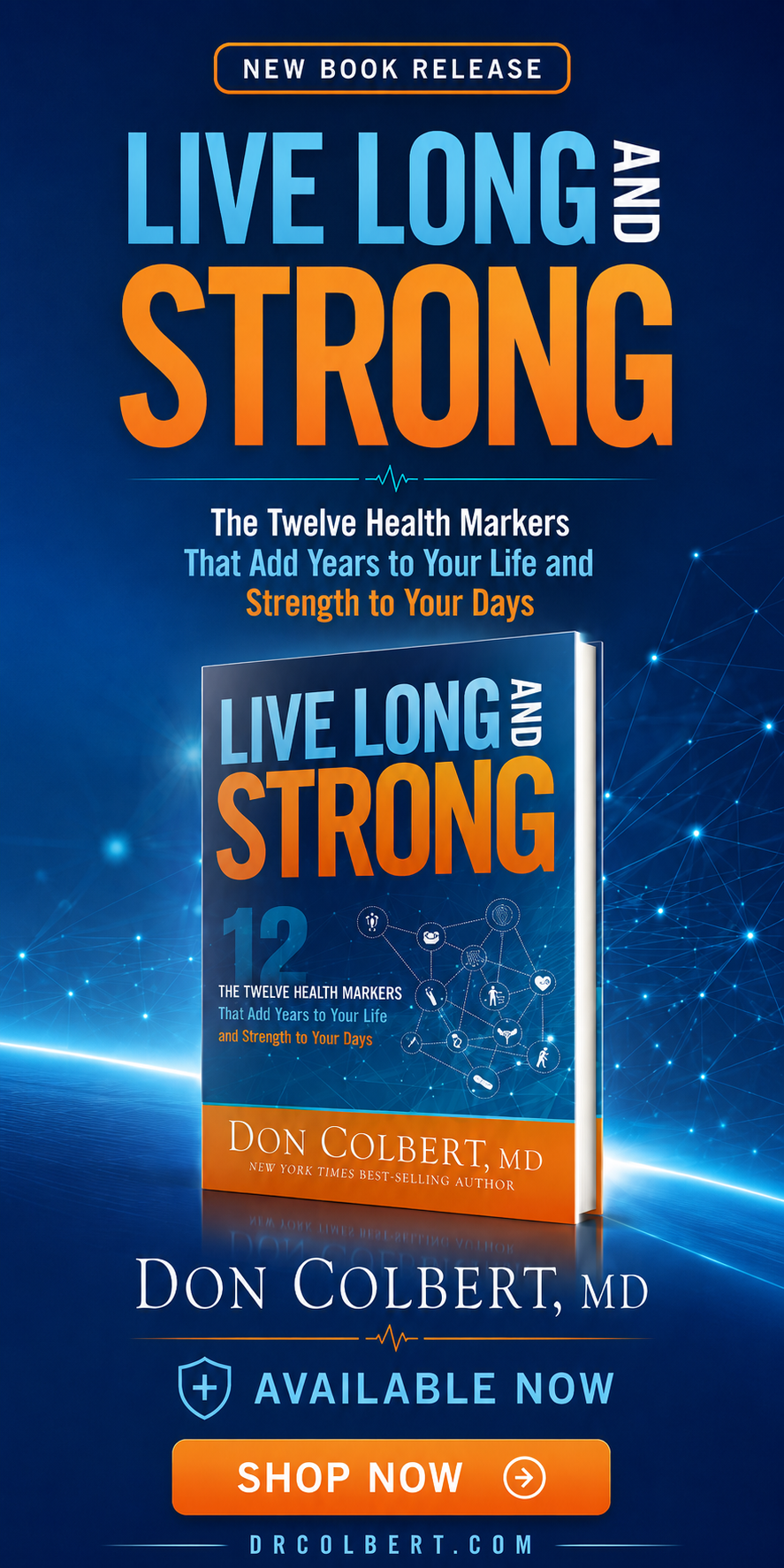
The 12 health markers that add years to your life and strength to your days — a faith-based, physician’s guide to lasting energy and vitality.
Resources and next steps
Pick one nutrient to start with this week, get your levels checked, and keep learning with Dr. Colbert.